
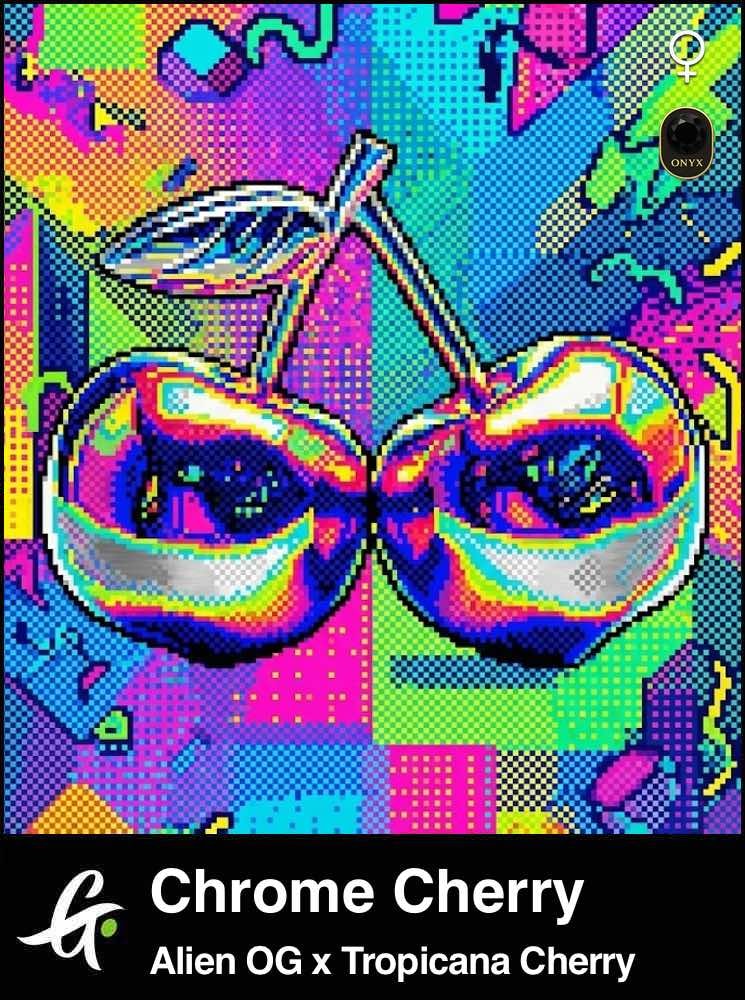
Chrome Cherry
Limited Edition. The alchemical resurrection of the Maroon Queen. Chrome Cherry solves a genetic paradox by dropping the loud, V12 engine of Tropicana Cherry (Relentless Cut) into the stunning but silent chassis of the “Super Maroon” Alien OG. This is a high-stakes “Engine Swap” for the elite collector—expect rock-hard buds with a metallic maroon fade, “Chrome” resin rails, and a sensory assault of kerosene-soaked cherries.
Harvested: December 2025
Chrome Cherry: The Alchemical Resurrection of the Maroon Queen
Introduction: The Infinite Pursuit of the Keeper
In the rarefied air of high-stakes cannabis breeding, there exists a tension that defines every decision, every cross, and every seed pop. It is the tension between the “Legacy” and the “Hype,” between the rugged, gas-soaked functionality of the past and the hyper-photogenic, candy-coated allure of the present. We are living in the era of the “Instagram Strain,” where a plant’s value is often determined by its ability to stop a scrolling thumb rather than its ability to stop a train of thought. Bag appeal has become the currency of the realm, often at the expense of the visceral, soul-shaking potency that defined the legends of the 90s.
I am Caesar THCzar, and my beat is the intersection of this history and this hype. I don’t write for the casual consumer who buys pre-rolls based on THC percentages printed on a label. I write for the pheno-hunters, the basement breeders, and the connoisseurs who understand that “The Keeper” is not found; it is forged. Today, we are dissecting a project that sits directly on this fault line: Chrome Cherry.
Bred by Greenpoint Seeds—a house whose DNA is inextricably linked to the gritty, chemical-laden history of the I-95 corridor—Chrome Cherry is an ambitious attempt to resolve a genetic paradox. It is the marriage of a “Super Maroon” Alien OG mother, a plant of devastating visual beauty but tragic silence in the terpene department, with the “Relentless Cut” of Tropicana Cherry, a modern exotic that screams with the volume of a thousand cherries.
This report is not merely a product description; it is a genealogical excavation. To understand Chrome Cherry, we cannot simply look at the seeds in the pack. We must travel back to the Hindu Kush mountains where the Alien lineage was born in the rucksack of a soldier. We must revisit the garages of Lake Tahoe where the OG legend was solidified. And we must dissect the modern “Exotic” movement that has elevated Tropicana Cherry to the pantheon of elite cuts.
This is a story of resurrection. It is the story of taking a “terpless” queen—a Ferrari with no engine—and dropping in a V12 twin-turbo motor from the future. It is a gamble, a science experiment, and a love letter to the plant, all wrapped in a maroon and chrome chassis. Welcome to the deep dive.
Part I: The Architect – Greenpoint Seeds and the I-95 Ethos
Before we touch the genetics of Chrome Cherry, we must understand the hands that crafted it. In the world of breeding, “intent” is as important as “input.” A breeder’s philosophy dictates what they keep and what they cull. Greenpoint Seeds is not a California hype brand chasing the latest dessert strain. It is a brand rooted in the I-95 Corridor, a stretch of highway that holds a mythical status in cannabis lore.
The Shadow of the Chem Dog
The I-95 corridor—running from the humid swamps of Florida up through the concrete canyons of New York City and into the rocky soil of New England—is the birthplace of the American gas profile. This is the land of Chem Dog, Sour Diesel, and Piff (Haze). It is a market that has historically been ruthless. In the 90s, if you brought “pretty” weed to Washington Square Park or the cipher in Philly, but it didn’t stink through the bag, you were laughed out of the spot. “The Nose knows” was the only rule.
The Mechanics of the “Terpless” Gamble
The decision to use the “Super Maroon” Alien OG is a significant pivot. It signals a recognition that the market has evolved. Today, visual appeal (bag appeal) drives the initial sale. The “Insta-Weed” generation buys with their eyes. The Super Maroon Alien is described as a “10/10” visually—a plant that fades to a deep, blood-red maroon, covered in a “chrome” layer of trichomes.
However, for a breeder like Gu, “terpless” is a fatal flaw. In the wild, this plant would be culled. But breeding is alchemy. The logic here is that the structure and color of the Alien are so elite, so statistically rare, that they are worth saving. The “terpless” trait is viewed as a “fixable” recessive flaw. By crossing it to a male with dominant terpene production (Tropicana Cherry), the goal is to “wake up” the silent queen. It is the ultimate flex: to take a plant that is broken in the nose department and fix it, creating a strain that has the “Old World” structure of the Alien and the “New World” nose of the Trop. It is the I-95 ethos evolving—applying the demand for “Loud” to a chassis that was previously silent.
Part II: The Mother – Alien OG and the Soldier’s Gift
To understand the mother of Chrome Cherry, we must leave the East Coast and travel to the rugged terrain of the Hindu Kush. The Alien OG lineage is one of the most storied and debated bloodlines in cannabis history. It represents the collision of pure landrace genetics with the hybridized power of the West Coast.
The Legend of Alien Technology
The story begins with Alien Technology (Alien Tech), the grandfather of the Alien OG. According to industry lore, which has been repeated on forums like ICMag and THCFarmer for nearly two decades, the seeds for Alien Tech were brought to the United States by a soldier returning from Afghanistan.
This soldier allegedly collected landrace seeds from a remote village in the Afghan mountains—a region known for producing hashish cultivars that have been stabilized over centuries of open pollination and farmer selection. These “Landrace Indicas” are characterized by their squat stature, broad leaves, and incredible resin production. They evolved to protect themselves from the harsh UV radiation of high altitudes and the arid climate, producing a thick, waxy cuticle and a dense coating of trichomes.
The seeds were gifted to a breeder known as Obsol33te Genetics (Obsoul33t). From this batch, a male was selected that displayed extraordinary vigor and resin production. This was the Alien Technology. It was a “Hash Plant” in the truest sense—engineered by nature for extraction. It possessed a spicy, earthy, cedar-wood aroma with hints of vanilla, but its primary value was its structure and resin.
The Cali Connection Era and the Birth of Alien OG
The Alien Tech male was first crossed with the Las Vegas Purple Kush (LVPK) to create Alien Kush. The LVPK is a clone-only cut famous for its deep purple coloration and coffee/lavender terpene profile. This cross injected the purple gene into the Alien pool.
The lineage took its final form when Swerve from The Cali Connection acquired the Alien Kush genetics. Swerve, a controversial but pivotal figure in bringing OG genetics to seed form, crossed the Alien Kush male with the Tahoe OG female.
The Tahoe OG is widely considered one of the heaviest hitting OG phenotypes. Discovered in the Lake Tahoe area (allegedly from a bag of Chem 91 seeds, though some claim it is an S1 of the original OG), the Tahoe cut is known for its intense “Lemon Pledge,” pine, and fuel aroma. It is a “lung-buster,” expanding rapidly in the chest and delivering a narcotic, sedative stone.
When Swerve crossed the sturdy, hash-producing Alien Kush with the lanky, potent Tahoe OG, Alien OG was born.
The “Super Maroon” Phenotype: A Genetic Anomaly
The Alien OG line became famous for fixing the primary issue with OG Kush: yield. While OGs are typically viney and low-yielding, the Alien OG produced massive, rock-hard colas thanks to the Afghan influence. However, the line was notoriously variable.
The mother of Chrome Cherry is a specific, rare phenotype of Alien OG described as “Super Maroon”. This plant is a genetic anomaly. Most Alien OGs are green with slight purpling. This specific cut expresses a deep, systemic anthocyanin production that turns the plant a bruised, blood-red color, distinct from the vibrant violet of modern Gelato crosses. This “Maroon” coloration is likely a callback to the LVPK grandmother, amplified by the harsh Afghan genetics.
But, as noted, she is “terpless.” This phenomenon—where a plant looks 10/10 but smells 2/10—is often a result of the energy trade-off in the plant’s metabolism. The energy required to produce such extreme pigmentation and resin density may have come at the cost of volatile monoterpene production. Or, more likely, she produces heavy, non-volatile sesquiterpenes that don’t “gas off” at room temperature, making her smell muted until combusted.
This mother represents the “Structure” half of the equation. She provides the chassis: the density, the yield, the maroon color, and the resin rails. She is the canvas waiting for the paint.
Part III: The Father – Tropicana Cherry and the Flavor Revolution
If the Alien mother is the stoic, silent Afghan queen, the father is the loud, flamboyant American pop star. Tropicana Cherry (specifically the Relentless Genetics Cut) is the defining strain of the “Modern Exotic” era.
The Lineage: From Cookies to Trop
To understand Tropicana Cherry, we must trace the evolution of “Purple Weed” in the US market. For decades, purple strains like Granddaddy Purple (GDP) and Purple Urkle were viewed with suspicion by serious smokers. They tasted great (grape, berry) but lacked the “punch” of the green OGs and Chems. They were “bedroom weed” or “gateway weed.”
That changed with Tropicana Cookies. Bred by Harry Palms (originally of Oni Seed Co), Tropicana Cookies was a cross of the Tangie and the Girl Scout Cookies (Forum Cut). The Tangie brought an aggressive, artificial orange terpene profile—like Tang powder—while the Cookies brought density and potency. Crucially, Tropicana Cookies was one of the first strains to produce purple trichome heads. When washed for ice water hash, the water turned blood red.
Relentless Genetics and the Cherry Evolution
Relentless Genetics, a Southern-based breeding team, took the Tropicana lineage to the next level. They crossed the Tropicana Cookies with Cherry Cookies F3 to create Tropicana Cherry (Trop Cherry).
The Relentless Cut of Tropicana Cherry is currently one of the most hunted and hoarded cuts in the game. Why? Because it solved the “Tangie Problem.” The Tangie terpene is polarizing; some love it, but many find it cloying and one-dimensional. The Cherry Cookies genetics tempered that orange aggression, shifting the profile toward rotten cherries, fruit punch, and deep red wine.
The “Purple Sativa” Morphology
Structurally, the Relentless Cut of Trop Cherry is a paradox. It displays the deep purple/pink coloration of an Indica, often turning almost black by harvest. However, its growth habit is distinctly Sativa. It stretches significantly in flower, has large internodal spacing, and produces long, spear-like colas.
This “Purple Sativa” morphology is critical for the Chrome Cherry cross. The Alien OG mother is a squat, dense, leafy plant that can be prone to mold due to its cabbage-like structure. The Trop Cherry father brings vegetative vigor and “openness” to the structure. It acts as a structural scaffold, stretching out the Alien genetics to allow for better airflow and light penetration, while maintaining the bag appeal.
Prepotency and The Dominant Male
In breeding, certain plants are known as “Prepotent,” meaning they pass on their traits with high consistency to their offspring. The Relentless Trop Cherry male is famously prepotent for Color and Terpenes. It is a “paint brush” male. It paints its progeny in shades of pink and violet and imparts a strong fruity/citrus nose.
This makes it the perfect partner for the “terpless” Alien mother. The Trop Cherry doesn’t just add flavor; it forces flavor into the cross. It is the genetic “loudspeaker” required to amplify the muted signals of the Alien.
Part IV: The Breeding Logic – Why Chrome Cherry Works
The marriage of Alien OG and Tropicana Cherry is not a random “pollen chuck.” It is a calculated move based on the principles of Heterosis (Hybrid Vigor) and Complementary Traits. Let’s break down the scientific and phenotypic logic behind this cross.
1. The “Engine Swap” Theory
As established, the Chrome Cherry project is fundamentally an “Engine Swap.”
- The Chassis (Alien OG): We are keeping the Maroon Fade, the Resin Density (Trichome coverage), and the Bud Hardness. Alien buds are rock-hard; Trop buds can be slightly airy or “larfy” if not grown perfectly. The Alien solidifies the Trop.
- The Engine (Trop Cherry): We are swapping out the muted, earthy terpene profile of the Alien for the High-Volatile Monoterpenes (Limonene, Myrcene) of the Trop Cherry. The goal is a plant that looks like the Alien but smells like the Trop.
2. Structural Synergy: The “Vine vs. Rock” Balance
- Alien Structure: Short internodes, broad leaves, thick stems. Can be too bushy.
- Trop Structure: Long internodes, thin leaves, stretchy stems. Can be too lanky.
- The Synergy: The F1 offspring should display an “Intermediate” habit. The Alien genetics will rein in the excessive stretch of the Trop, making it more manageable for indoor tent growers. Conversely, the Trop genetics will open up the canopy of the Alien, reducing the risk of micro-climates that lead to bud rot. We are aiming for “Donkey Dicks”—long, continuous colas that have the density of the Alien but the length of the Trop.
3. The Color Spectrum: Maroon Meets Violet
This is a nuanced point for the connoisseur. The market often lumps all “purple weed” together, but chemically, there are differences.
- Anthocyanin Profiles: The Trop Cherry produces anthocyanins (purple pigments) early in flower, often triggered by genetics regardless of temperature. The Alien OG produces its “Maroon” color as a response to Senescence (aging) and cold temperatures, often degrading chlorophyll to reveal carotenoids and late-stage anthocyanins.
- The “Chrome” Result: The combination of these two pathways creates a dynamic color shift. The phenotypes we are hunting for will start with the pink/purple hues of the Trop in weeks 3-5, and then deepen into a dark, metallic maroon in weeks 7-9. This layering of pigment, underneath a heavy coat of white resin, creates the “Chrome” effect—a shiny, metallic, dark cherry appearance that is visually distinct from standard purple strains.
4. Terpene Modulation: The “Spiced Cherry”
The goal isn’t just to have the plant smell like Trop Cherry. If we wanted that, we would just grow Trop Cherry. The goal is Modulation. We want the “Gas” and “Hash” notes from the Alien/Tahoe lineage to interact with the “Fruit” of the Trop.
- The Target Profile: We are looking for a “Fermented Fruit” profile. Think of cherries soaking in kerosene, or a fruit punch spiked with vodka. The “Chemical” notes of the I-95 influence (from the Alien’s Tahoe heritage) should cut through the sweetness of the Cherry, adding a “Grown Up” complexity to the flavor. It shouldn’t just be candy; it should be dangerous candy.
Part V: The Phenotype Hunt Guide – Finding the Keeper
You have cracked the pack. You have 12 seedlings reaching for the light. Statistically, in an F1 cross of two divergent poly-hybrids, you are going to see variation. As your guide, I will walk you through the selection process, stage by stage, to ensure you identify the Chrome Cherry Keeper.
Stage 1: The Seedling/Veg Vigor Check
- The “Runt” Warning: In many crosses, the runts are culled. Do not cull the runts of Chrome Cherry immediately. The Alien OG mother is a slow vegetative grower compared to the vigorous Trop. A plant that is growing slower might be holding the precious Alien density traits. Give them time.
- The Stem Rub: This is your first terpene check. Gently rub the stem of the vegetative plant.
- Smells like Green/Grass: Mark as “Potential Cull.” This could be the terpless mother trait surfacing.
- Smells like Orange/Tangerine: This is a Trop-dominant pheno. Likely good, but maybe too common.
- Smells like Burnt Rubber & Berry: Mark as Elite. This indicates the gas of the Tahoe/Alien is already mixing with the fruit of the Trop.
Stage 2: The Stretch (Weeks 1-3 of Flower)
- The “Viney” Pheno: If a plant stretches 3x its height (e.g., goes from 1ft to 3ft), it is leaning heavily toward the Trop/Tangie sativa side. These often yield lower density buds. Keep only if you have high ceilings and good lighting.
- The “Cabbage” Pheno: If a plant barely stretches (less than 1.5x), it is the Alien dominance. These will yield rock hard nuggets but might be slow to finish.
- The Keeper Structure: You want the 2x Stretch. A plant that doubles in size, creating strong lateral branches that can support weight without flopping over. This is the Hybrid Vigor sweet spot.
Stage 3: The Color Reveal (Weeks 4-6)
- The “Pink Pistil” Pheno: Look for plants where the pistils (hairs) themselves turn pink or red early in flower. This is a signature Relentless Trop trait. These plants often have the best bag appeal.
- The “Black Leaf” Pheno: Some phenos will have leaves that turn almost black while the buds remain bright green/purple. This contrast is visually stunning and often indicates high resin production.
Stage 4: The Harvest Check (Weeks 8-9) – The Decision
This is where you make your final call. You are judging on three criteria: Nose, Density, and Chrome.
| Phenotype | Probability | Visuals | Nose | Verdict |
|---|---|---|---|---|
| The “Silent Alien” | 25% | 10/10. Deep maroon, incredibly frosty, rock hard. | 3/10. Faint earth, cardboard, maybe a little pine. | CULL. This is the mother’s curse coming back to haunt you. Do not be seduced by the looks. If it don’t stink, it don’t stay. |
| The “Loose Trop” | 25% | 7/10. Bright purple, pink hairs, but the buds are spongy and airy. | 9/10. Loud orange soda and cherries. | Extracts Only. This plant will wash well (make good hash) but the flower structure is lacking for the “Headstash” jar. |
| The “Chrome Keeper” | 50% | 9.5/10. Dark, metallic maroon buds that are dense and heavy. They make a “thud” when dropped on the table. | 9/10. A complex layering of Maraschino Cherry, Jet Fuel, and Old Leather. It hits the nose sharp (the chemicals) and finishes sweet (the fruit). | KEEPER. This is the plant Gu envisioned. Clone it, mother it, and share it with only your closest circle. |
Part VI: Cultivation Masterclass – Growing the Chrome
Chrome Cherry is an elite hybrid, but elite genetics require elite cultivation. This is not a “plant it and forget it” strain like Blue Dream. It requires a nuanced understanding of Crop Steering.
1. Feeding Strategy: The “Fade” Management
- Nitrogen Sensitivity: The Alien OG mother is sensitive to Nitrogen toxicity, often displaying “The Claw” (leaves curling down) if fed too hot. However, the Trop father is a hungry feeder.
- The Solution: Use a Stepped Feeding Program.
- Veg: Medium EC (1.8 – 2.0).
- Early Flower (Wk 1-4): Push the EC high (2.4 – 2.8). The Trop vigor needs fuel for the stretch.
- Late Flower (Wk 6-9): Aggressive Flush. You must cut Nitrogen completely in the final 3 weeks. To achieve the “Super Maroon” color of the mother, the plant must be allowed to cannibalize its own chlorophyll. If you feed Nitrogen until the end, you will get murky brown buds, not Chrome Cherry.
2. Environmental Controls: The VPD Dance
- Vapor Pressure Deficit (VPD): To maximize the “Chrome” resin production, you need to stress the plant slightly in late flower.
- Veg/Early Flower: Maintain optimal VPD (0.8 – 1.1 kPa) for maximum growth.
- Late Flower: Increase the VPD (1.3 – 1.5 kPa). Drier air forces the plant to close stomata and produce more trichomes to protect against desiccation.
- Temperature Differential (DIF): This is the secret to the color. You need a high differential between day and night temps in the final 2 weeks.
- Day: 75-78°F.
- Night: 60-65°F.
- This 15-degree drop mimics the autumn conditions of the Hindu Kush and the high altitudes, triggering the massive anthocyanin dump that creates the maroon fade.
3. Training: Support is Mandatory
While the Alien adds stem thickness, the weight of the potential yields from the Trop side means these plants will get top-heavy.
- Trellising: A double trellis is recommended. One at 2 feet (to spread the canopy) and one at 4 feet (to support the heavy colas).
- Topping: Top the plant early (at the 5th node) to break apical dominance. The Trop genetics respond well to “manifolding” or “main-lining,” creating 8-10 equal-sized colas rather than one main spear.
Part VII: Cultural Context – The “Headstash” vs. The “Hype”
In the final analysis, Chrome Cherry is a strain that occupies a unique space in the market. We are currently seeing a backlash against the “Candy” domination of the last 5 years (Zkittlez, Runtz, Gelato). Smokers are getting “terp fatigue.” They are tired of weed that tastes like perfume but smokes like air.
There is a resurgence of interest in Power. Smokers are looking back to the OGs and the Chems, seeking that “chest-hit” expansion and the heavy, narcotic stone that only comes from those lineages. But they refuse to sacrifice the visual standards set by the Exotics.
Chrome Cherry is the bridge.
- For the “Insta-Weed” Crowd: It has the purple/pink/maroon colors and the frost rail that guarantees likes on social media. It fits the “Exotic” aesthetic perfectly.
- For the “I-95” Soldier: It has the density, the weight, and the chemical/fuel undertones that demand respect. It is not “soft” weed. It is heavy smoke wrapped in a pretty package.
The Lore of the “Chrome”
The name itself—Chrome Cherry—is a nod to this duality. “Cherry” represents the flavor, the sweetness, the Relentless genetics. “Chrome” represents the hardness, the machinery, the Alien technology, and the industrial grit of the I-95 corridor. It is organic matter mimicking metal.
Conclusion: The Final Verdict
Greenpoint Seeds has taken a calculated risk with Chrome Cherry. By resurrecting a “terpless” mother, they are betting that their breeding prowess can fix nature’s mistake. The data suggests they are right. The prepotency of the Tropicana Cherry male is a known quantity; it is a terpene dominant plant. The structure of the Alien OG is legendary.
If you are a grower looking for a “safe” bet—a plant that yields decent mid-grade with generic smell—look elsewhere. Go grow Blue Dream.
But if you are a hunter, a gambler, and a connoisseur who understands the history of the plant—from the mountains of Afghanistan to the parking lots of Grateful Dead shows to the modern labs of Colorado—then Chrome Cherry is your next project.
The hunt is on. Find the phenotype that has the Maroon Chassis and the Cherry Engine. Find the Chrome.
Appendix: Cultivation Data & Genetic Maps
| Parent Strain | Breeder/Source | Primary Contribution | Key Traits | Risk Factor |
|---|---|---|---|---|
| Alien OG (Mother) | Cali Connection (Swerve) | Structure & Density | Rock-hard buds, Maroon Fade, “I-95” Gas profile potential (recessive). | “Terpless” Pheno: Risk of low terpene offspring if father doesn’t dominate. |
| Tropicana Cherry (Father) | Relentless Genetics | Flavor & Color | Loud Cherry/Citrus nose, Early Purple (Anthocyanins), Hybrid Vigor. | “Larf” Structure: Risk of airy buds if mother doesn’t dominate. |
| Chrome Cherry (Progeny) | Greenpoint Seeds | The Synthesis | “Chrome” visual appeal (Silver on Maroon), “Spiced Fruit” nose, Heavy Yield. | Pheno Variation: Requires hunting to find the perfect blend. |
| Stage | Week | Target EC | Target PPM (500 scale) | Key Nutrient Focus | Environmental Target |
|---|---|---|---|---|---|
| Seedling | 1-2 | 0.8 – 1.0 | 400 – 500 | Root Stimulants, low N | High Humidity (65-70%) |
| Veg | 3-5 | 1.5 – 1.8 | 750 – 900 | Nitrogen for structure | Moderate Humidity (60%) |
| Transition | 6 (Flip) | 1.8 – 2.0 | 900 – 1000 | CaMg boost for stretch | Lower Humidity (55%) |
| Early Flower | 7-10 | 2.2 – 2.6 | 1100 – 1300 | PK boost for bud sites | High Light Intensity |
| Bulk | 11-13 | 2.4 – 2.8 | 1200 – 1400 | Peak PK, maintain CaMg | Max VPD (1.2 – 1.4) |
| Ripen/Fade | 14-15 | 1.0 – 1.2 | 500 – 600 | Cut Nitrogen completely | Drop Night Temps (60°F) |
| Flush | 16 | 0.0 – 0.2 | 0 – 100 | Pure Water | Lowest Humidity (40%) |
| Note | Source | Description | Detection Guide |
|---|---|---|---|
| Primary | Trop Cherry | Rotten Cherry / Fermented Fruit | Sweetness that hits the front of the tongue. Should taste like dark red wine. |
| Secondary | Alien OG | Chemical / Solvent / Fuel | A sharp, stinging sensation in the nose (Trigeminal nerve). Smells like a marker pen. |
| Tertiary | Alien Tech | Earthy / Hash / Cedar | The base note on the exhale. A woody, incense quality that lingers. |
| The “Chrome” | Synergy | Metallic / Hairspray | A unique synthesis of the chemical and the fruit. Smells like “Cherry Hairspray.” |
| Quantity | Full pack – 6 feminized photoperiod seeds, Wholesale – 10 packs, Wholesale – 20 packs, Wholesale – bulk 1,000 seeds, Wholesale – bulk 100 seeds, Wholesale – bulk 500 seeds |
|---|---|
| Seed Sex | |
| Cannabis Type | |
| Flowering Length | |
| Lineage | |
| Brand |
Related products

Reviews
There are no reviews yet