
Cuban Black Haze (The “Piff”)
In the pantheon of cannabis history, few strains command the reverence—or the price tag—of the Cuban Black Haze. Known colloquially in the Northeastern United States as “Piff,” “Uptown Haze,” “Frankie,” or “The Church,” this cultivar is not just a plant; it is a survivor of the Prohibition era. Unlike modern commercial poly-hybrids designed for bag appeal and speed, the Cuban Black Haze is a wild, untamed Sativa that demands patience and rewards the connoisseur with an experience that has virtually vanished from the modern market.
The Lineage: A Dutch Seed, A Miami Selection
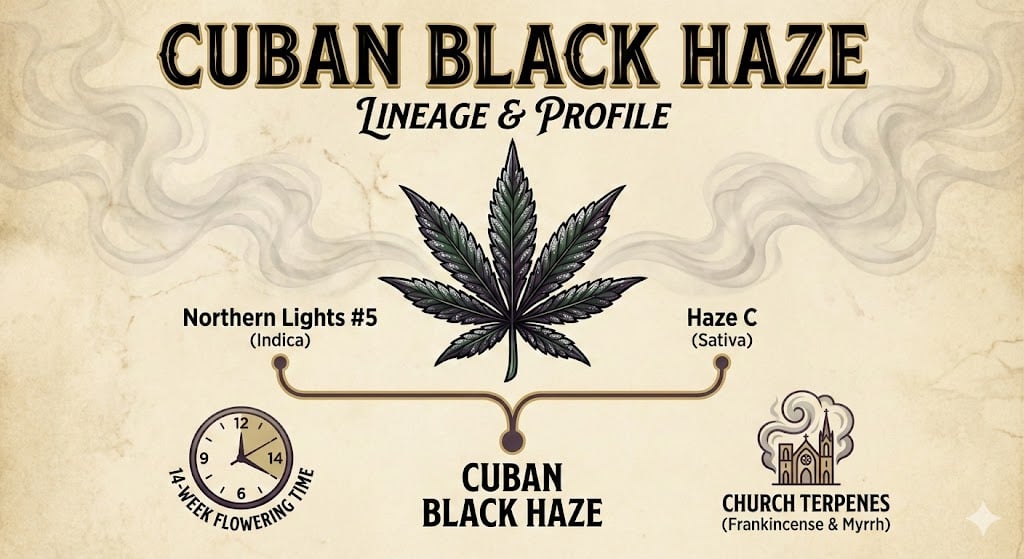
The genetic chassis of the Cuban Black Haze is Northern Lights #5 x Haze. However, it is critical to understand that this is not a standard representation of that cross.
-
The Architect: The seed line was created in 1989 by Nevil Schoenmakers at The Seed Bank of Holland. He crossed a Northern Lights #5 female (Indica) with a “Haze C” male (Sativa).
-
The Phenotype: While many plants from this cross leaned toward the faster-flowering Northern Lights parent, the Cuban Black Haze is a rare, recessive Haze-dominant phenotype.
-
The Selection: The specific cut was identified in the early 1990s by Cuban-American growers in Miami. They selected it for its resistance to mold in high humidity and its unique ability to turn a deep, menacing purple—almost black—late in the flowering cycle.
Botanical Characteristics & Growth Structure
The Cuban Black Haze is an anomaly in the garden. It defies the commercial logic of “cash cropping.”
-
Morphology: This plant is an aggressive vertical grower. It stretches massively, producing “foxtails” or “wheat sheaves”—loose, airy clusters of calyxes rather than dense nuggets. This open structure allows for airflow, an evolutionary adaptation to the humid Florida climate where it was selected.
-
The “Black” Trait: True to its name, the foliage and calyxes can turn a deep violet/black. This is distinct from the reddish hues of Colombian varieties; it is a genetic trait triggered by senescence and cooler temperatures.
-
Flowering Time: This is the barrier to entry. The Cuban Black Haze requires 14 to 16 weeks (100-120 days) to fully mature. It matures from the “inside out,” often pushing new white pistils even when the internal resin is ripe.
Terpene Profile: The “Church” Aroma
The most defining characteristic of the Cuban Black Haze is its smell. It lacks the fruit or gas notes common in modern weed. Instead, it possesses a distinct Frankincense and Myrrh profile, often described as metallic, woody, or like “Church” incense. This is likely due to a high concentration of rare sesquiterpenes and Terpinolene.
The High: Ceiling-less Sativa
The effects of Cuban Black Haze are stimulating, clear-headed, and sometimes racy. Users report a “ceiling-less” high that functions more like a strong espresso than a sedative. It provides an energetic, psychedelic experience that fueled the nightlife of New York City for two decades.